
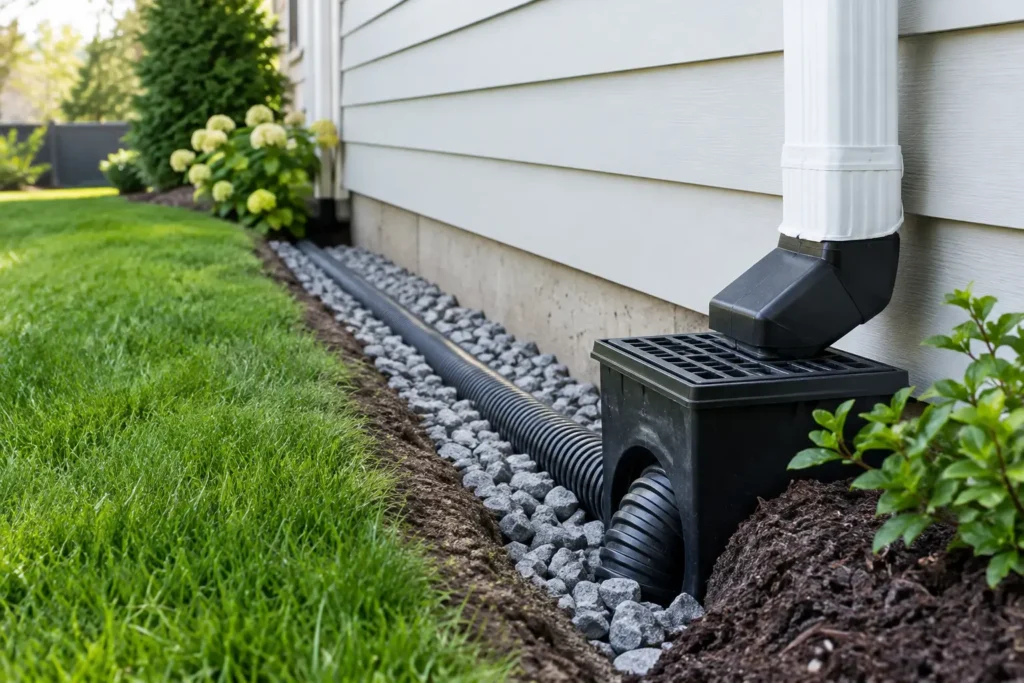
Water should leave your property without pooling beside the foundation, spilling over gutters, or finding a path into a basement wall. The best exterior drainage solutions do more than move visible puddles – they control where water starts, how it travels, and where it can safely discharge without creating a new problem.
For homes and commercial properties across the Mid-Atlantic, drainage planning matters because heavy rain, clay-heavy soil, freeze-thaw cycles, mature landscaping, and aging construction can work together to direct water toward the building. A damp basement, stained foundation wall, eroded mulch bed, or recurring roof leak may all be signs that the drainage system needs attention.
The right fix depends on the source of the water. A contractor should evaluate roof runoff, ground slope, hardscape elevations, foundation conditions, buried drainage lines, and signs of active moisture before recommending a system. Installing a drain without correcting the source can shift water from one trouble spot to another.
Best Exterior Drainage Solutions by Water Source
Gutters and properly sized downspouts
Roof runoff is often the first drainage issue to address. A single inch of rain can send hundreds or thousands of gallons of water off a roof, depending on its size. If gutters are clogged, undersized, loose, or poorly pitched, water can overflow directly along the foundation and saturate the soil below.
Clean, securely fastened gutters with correctly placed downspouts are a practical first line of defense. Downspouts should carry water away from the structure through extensions or underground solid piping. Simply allowing a downspout to empty beside the wall rarely solves a moisture problem, even if the area looks dry shortly after the storm.
This approach is especially effective when water appears at isolated corners of the building or when overflowing gutters are visible during rain. It is not enough, however, when the entire yard slopes toward the home or groundwater is entering below grade.
Regrading and swales
The ground around a foundation should generally slope away from the building so surface water does not collect against walls, window wells, or exterior doors. Over time, soil settles, landscaping changes, patios are added, and mulch builds up. These small changes can reverse the intended slope and create a channel toward the structure.
Regrading restores positive drainage by reshaping the soil to guide water away. A shallow, landscaped swale can also collect and redirect runoff across the yard toward an appropriate discharge area. This is often one of the most effective solutions for widespread surface water because it addresses the path water naturally wants to take.
The trade-off is that grading must be planned carefully around utilities, driveways, neighboring properties, walkways, and local drainage requirements. Soil should not be placed so high that it covers siding, blocks weep holes, or bridges termite inspection clearances. A properly designed grade protects the structure without trapping moisture against exterior finishes.
French drains for saturated soil
A French drain is a perforated pipe installed in a gravel-filled trench, usually wrapped in filter fabric. It collects water moving through saturated soil and directs it to a safe outlet. This type of system can work well where rainwater repeatedly collects in a low area, along a retaining wall, or near a foundation despite improved surface grading.
French drains are frequently misunderstood as a one-size-fits-all basement repair. They can reduce hydrostatic pressure and redirect groundwater, but performance depends on pipe depth, slope, gravel coverage, soil type, cleanouts, and a reliable discharge point. A drain with no outlet or inadequate slope can fill with sediment and stop functioning as intended.
For foundation applications, excavation may also create an opportunity to inspect the wall, repair cracks, install exterior waterproofing, and protect the membrane with drainage board. That work is more involved than adding a shallow yard drain, but it may be appropriate when water is entering below grade through the foundation wall.
Catch basins and area drains
Catch basins and area drains manage concentrated surface water in locations where it cannot simply be reshaped away. Common examples include the bottom of a sloped driveway, patio edges, stairwells, courtyard areas, garage approaches, and low landscape beds.
An area drain uses a surface grate to collect runoff before it pools. A catch basin includes a sump area that can hold sediment and debris before water enters the outlet pipe. Both systems require periodic cleaning. Leaves, mulch, roof granules, and soil can block a grate or reduce the capacity of the basin during a storm.
These drains are effective for clearly defined low points. They are less useful if the surrounding grading continually funnels excessive water into one small drain. In that case, the drain may be part of the solution, but grading and runoff control should be addressed first.
Channel drains for hardscapes
A channel drain is a long, narrow trench drain with a grated cover. It is commonly installed across garage entrances, at the edge of patios, near pool decks, or in commercial loading and entry areas where broad paved surfaces shed water quickly.
Because hardscapes do not absorb rain, runoff can move fast and overwhelm standard point drains. Channel drains intercept that sheet flow along a continuous line. They need correct elevation, pipe sizing, and discharge planning to prevent standing water or backups.
This solution is particularly valuable when a driveway slopes toward a garage or a patio directs water toward an exterior door. It should be integrated with the larger drainage plan, not treated as an isolated feature.
When Exterior Waterproofing Is the Better Answer
Drainage and waterproofing are related, but they are not the same service. Exterior drainage controls water around the building. Exterior waterproofing protects the foundation wall from moisture intrusion when excavation exposes the below-grade structure.
If moisture mapping, visible seepage, recurring efflorescence, or wall deterioration indicates water is entering through the foundation, the repair may require more than extending a downspout. The exterior wall may need cleaning, crack repair, a waterproof membrane, drainage board, and a footing drain connected to an approved outlet.
This is a major project, but it can be the right long-term repair for persistent below-grade water intrusion. It also gives the contractor a clear view of the foundation condition, which is not possible from inside the basement alone. Interior drainage systems can be useful in certain situations, but they manage water after it reaches the foundation rather than preventing exterior saturation.
How to Choose the Right Drainage Plan
Start with observations made during and immediately after rainfall. Look for overflowing gutters, downspout discharge near walls, water tracks across pavement, soft or sunken soil, standing water, peeling paint, damp basement edges, and erosion around landscaping. Photographs taken during a storm can help identify patterns that are not visible on a dry day.
Next, determine whether the water is coming from the roof, the surface of the yard, groundwater, a failed buried line, or a combination of sources. Many properties need layered protection: gutter corrections to control roof runoff, regrading to direct surface water, and a drain only where water naturally collects.
The discharge location is critical. Water must be directed to a suitable point that does not send it back toward the foundation, undermine a walkway, flood a neighbor’s property, or violate local requirements. In some cases, that may involve daylighting on a lower part of the property, connecting to an approved stormwater system, or using another code-compliant drainage approach.
A professional evaluation is particularly important when drainage problems are accompanied by active basement water, mold concerns, structural movement, damaged finishes, or storm-related roof and siding issues. Apollo Construction & Renovation Corp. can assess the visible damage, identify moisture pathways, document conditions, and coordinate restoration work when water intrusion has already affected the property.
Protect the System After Installation
No drainage system is maintenance-free. Gutters should be cleaned and inspected regularly, especially after leaf season and severe storms. Downspout outlets, drain grates, catch basins, and cleanouts should remain accessible and clear of mulch, soil, leaves, and ice.
Pay attention after landscaping projects, new patios, fence installations, or driveway repairs. These changes can alter grade and drainage patterns without appearing significant at first. If a formerly dry area begins to pond water, act before repeated saturation damages finishes, encourages mold growth, or reaches the foundation.
The strongest drainage plan is the one built around your property’s actual water path. Address the source, provide a clear route away from the structure, and maintain the system before the next heavy rain turns a manageable issue into a restoration project.
Every property and insurance policy is different. Contact Apollo to discuss the work your property may need; your insurer determines coverage.