
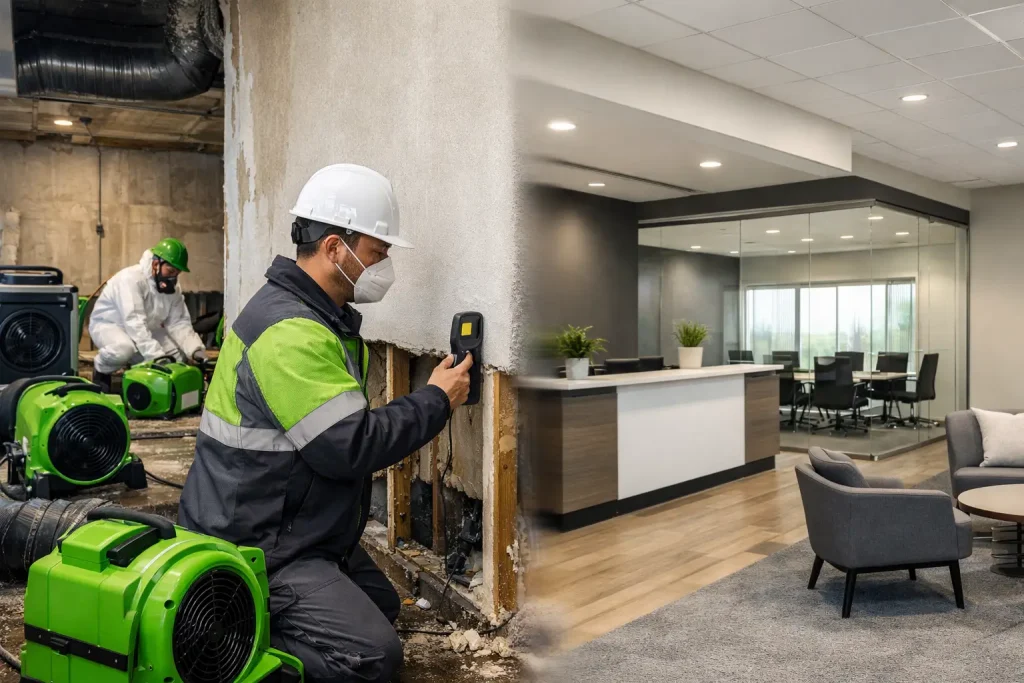
A pipe break at 2 a.m. does not just damage drywall or flooring. In a commercial building, it can interrupt tenants, shut down operations, create safety concerns, and put insurance timelines in motion before the sun comes up. That is why a strong commercial property damage repair guide matters. The right response in the first few hours can reduce business interruption, protect evidence for the claim, and prevent secondary damage that makes repairs more expensive.
Commercial losses are rarely simple. Water can travel behind walls and under flooring. Smoke can affect HVAC systems and contents far from the source. Storm damage can begin at the roofline and show up days later as interior staining, mold growth, or damaged insulation. For property owners and managers, the challenge is not just fixing what is visible. It is stabilizing the property, documenting conditions, coordinating multiple trades, and keeping the project moving without losing control of cost, scope, or safety.
What a commercial property damage repair guide should cover
The best commercial property damage repair guide starts with one principle: mitigation and repair are connected, but they are not the same phase. Mitigation is about stopping ongoing damage, protecting occupants, and stabilizing the building. Repair and reconstruction restore the property to pre-loss condition based on the approved scope.
That distinction matters because many claim delays and cost overruns start when emergency work is incomplete, undocumented, or disconnected from the reconstruction plan. A commercial project needs a clear chain from emergency response to final build-back. That includes moisture mapping, site safety controls, demolition decisions, material tracking, and communication with adjusters, engineers, tenants, and ownership.
A good contractor should be able to handle the field work and the paperwork. In practice, that means organized site documentation, photo records, equipment logs when mitigation is involved, and a repair scope that reflects code requirements, hidden damage, and the building’s operational needs.
Step 1: Prioritize safety and stop the source
Before anyone discusses finishes or timelines, the site has to be safe. Shut off water if there is an active plumbing leak. Isolate electrical hazards if water has reached wiring, panels, or equipment. Secure damaged roofing, broken windows, or unstable areas after a storm or fire event. If the building is occupied, control access immediately.
In commercial settings, safety also includes protecting tenants, employees, visitors, and vendors. A damaged retail space, office suite, warehouse, or multifamily common area can create liability exposure fast. Temporary barriers, clear signage, and controlled work zones are not optional details. They are part of responsible loss management.
This is also where trade-offs begin. A property may need to remain partially operational while repairs move forward. Sometimes that is realistic. Sometimes it increases risk, slows production, and raises cost. The right decision depends on the type of damage, occupancy, and whether critical systems have been compromised.
Step 2: Document the loss before conditions change
Commercial claims move better when the damage is documented thoroughly from day one. That includes wide-angle photos, close-up photos, affected room lists, visible material damage, equipment or contents impact, and notes on when the loss was discovered. If water is involved, moisture readings, thermal imaging, and drying records can be especially important.
Too many projects run into problems because the visible damage gets photographed, but the progression of the loss does not. For example, a roof leak may stain only a ceiling tile at first, while insulation, decking, framing, and wall cavities have already been affected. If the documentation is weak, the repair conversation becomes harder later.
For property managers, this step also helps with internal reporting. Ownership groups, boards, and asset managers usually want immediate clarity on what happened, what areas are affected, and what the next decision points will be.
Step 3: Mitigate quickly to limit secondary damage
Once the site is safe and the loss is documented, mitigation should begin without delay. In water losses, that can mean extraction, removal of unsalvageable materials, structural drying, dehumidification, and containment. After fire events, it may include board-up, emergency roof tarping, debris removal, odor control, and stabilization of affected assemblies. Storm losses may require temporary dry-in, selective demolition, and protection of exposed interiors.
Speed matters, but so does method. Over-demolition can increase claim complexity and cost. Under-mitigation can leave trapped moisture, hidden smoke residue, or contaminated materials in place. Commercial buildings often contain layered assemblies, specialty finishes, and occupied spaces that require a more controlled approach than a small residential loss.
This is one reason many owners prefer a full-service restoration contractor rather than separate emergency and repair vendors. When the team that documents the damage also understands reconstruction, the path to repair is usually more organized.
Step 4: Build the repair scope with operations in mind
Repairing a commercial property is not only a construction question. It is an operations question. A medical office, condominium common area, school-adjacent facility, mixed-use property, or warehouse each has different scheduling pressures, access needs, and code concerns.
The repair scope should address structural components, interior finishes, building systems, and any environmental or code-related items triggered by the loss. It should also account for sequencing. Roofing may need to be completed before interior reconstruction. Drying verification may need to happen before insulation and drywall. HVAC cleaning or replacement may need to be handled before occupancy resumes in affected zones.
A practical repair plan answers a few basic questions early. What must happen now to protect the building? What can be phased to reduce downtime? What materials have long lead times? What approvals are required before reconstruction starts? If these questions are delayed, the project often stalls in the handoff between mitigation and repair.
Step 5: Coordinate with insurance without losing project momentum
Insurance support is part of commercial restoration, but the repair process cannot wait for perfect conditions. The goal is to document clearly, communicate consistently, and keep necessary work moving within the claim framework.
That usually means separating emergency mitigation from reconstruction scope, tracking site conditions carefully, and making sure the estimate reflects actual loss-related damage rather than guesswork. It also means recognizing where judgment calls come into play. Hidden moisture, smoke migration, code upgrades, and matching issues can all affect the final scope.
For commercial owners, one of the biggest advantages in working with an experienced insurance restoration contractor is translation. Adjusters, engineers, managers, and tenants often use different language for the same problem. A contractor who can explain field conditions clearly and back them with documentation helps reduce friction and keep decisions moving.
Common repair issues that get missed
Not all damage announces itself early. Some of the most expensive problems appear after the emergency phase if the building was not evaluated thoroughly.
Roofing failures can affect insulation, decking, interior framing, and electrical pathways. Water losses in multifamily or office buildings may spread vertically through multiple units or suites. Smoke and soot can travel through ductwork and settle in contents or concealed spaces. Mold can begin developing quickly when moisture is not removed completely. Flooring damage may extend beyond visible staining, especially with glue-down products, underlayments, or subfloors.
Commercial properties also bring more complexity around specialty materials and systems. Elevator lobbies, server rooms, sprinkler systems, tenant improvements, and access-controlled spaces can all influence the repair strategy. A contractor needs to look beyond the first damaged room.
Choosing the right contractor for commercial damage repair
The lowest bid is not always the lowest cost once delays, rework, and documentation gaps show up. Commercial property owners should look for a contractor with emergency response capability, reconstruction depth, safety discipline, and real insurance restoration experience.
That includes proper licensing and insurance, clear project management, and technical documentation that supports both the repair and the claim. Certifications and inspection credentials matter, but so does practical execution. Can the contractor manage containment, drying, demolition, roofing, interior repairs, and final finishes under one plan? Can they communicate clearly with property stakeholders while the building is under stress?
In the Mid-Atlantic, Apollo Construction & Renovation Corp. handles this kind of work by combining mitigation, documentation, and reconstruction under one coordinated process. That kind of continuity can make a major difference when commercial properties need to recover quickly and correctly.
Commercial property damage repair guide for faster recovery
If there is one takeaway from this commercial property damage repair guide, it is this: early decisions shape the entire project. Fast response helps, but organized response is what protects the building, the claim, and the timeline.
When damage affects a commercial property, owners and managers do not need more confusion. They need a clear plan, disciplined documentation, safe mitigation, and repairs that account for how the building actually operates. The smoother the handoff from emergency work to reconstruction, the sooner the property gets back to serving the people who depend on it.
The next time a loss hits, focus on control before cosmetics. Stabilize the site, capture the facts, and bring in a team that can carry the job all the way through repair with urgency and accountability.
Every property and insurance policy is different. Contact Apollo to discuss the work your property may need; your insurer determines coverage.