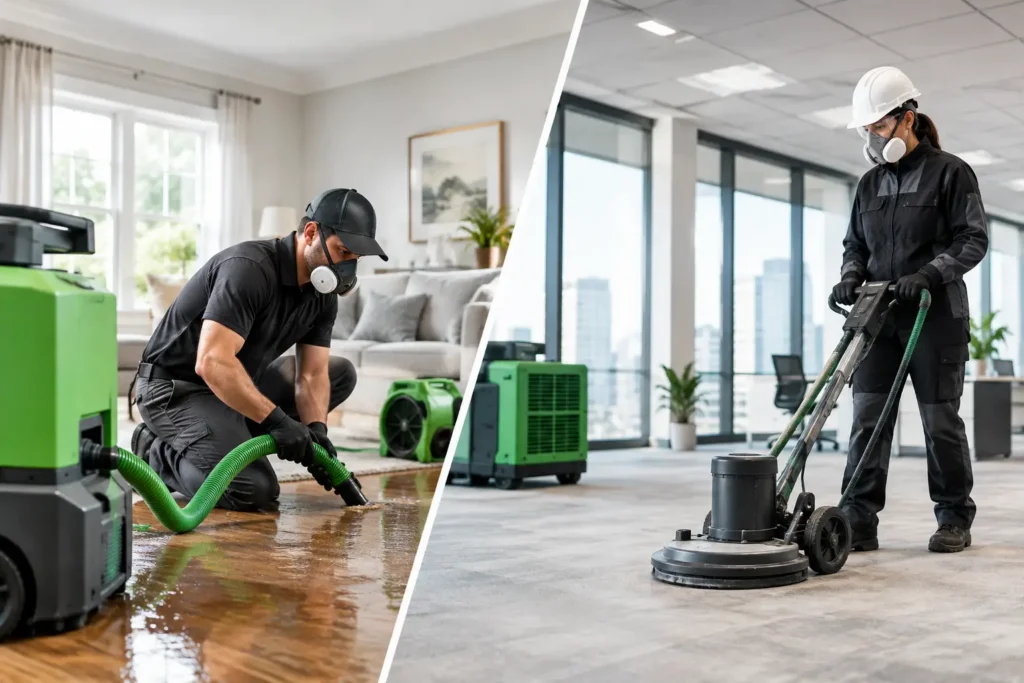
A burst supply line in a home can disrupt one family’s routines. The same failure in an office building, medical suite, retail center, or multifamily property can affect tenants, employees, customers, inventory, and daily operations at once. That is the central difference in residential versus commercial restoration: both require fast, technically sound recovery, but the planning, documentation, safety controls, and path back to normal can look very different.
Property damage does not wait for a convenient time. Whether the loss involves water, fire and smoke, storm damage, mold, or a roofing failure, the first priority is to stabilize the property and prevent conditions from getting worse. From there, the restoration strategy should reflect the building’s use, occupancy, systems, and insurance requirements.
What Both Types of Restoration Have in Common
Residential and commercial restoration begin with the same fundamental objective: protect people, stop the source of damage when possible, document conditions, dry or secure affected areas, and restore the property correctly. Cutting corners during mitigation can leave hidden moisture, smoke residue, compromised materials, or safety concerns that become more expensive later.
A qualified restoration team starts by assessing the extent of the loss rather than relying only on visible damage. Moisture mapping, thermal imaging, photographs, 360-degree imaging, and detailed job documentation help establish where water traveled, what materials were affected, and which areas require controlled drying, cleaning, removal, or reconstruction.
The insurance process also matters in both settings. Clear records of emergency services, affected materials, equipment placement, scope changes, and repair progress help property owners, managers, adjusters, and carriers understand the work being completed. Documentation does not replace an insurance carrier’s coverage determination, but it gives the claim a factual foundation.
Residential Versus Commercial Restoration: The Key Differences
The difference is not simply that commercial buildings are larger. A small restaurant, a condominium association clubhouse, and a single-family home may all sustain similar water damage, yet each property requires a different recovery plan.
Occupancy and business interruption
For homeowners, restoration often centers on preserving a safe, livable space and protecting personal belongings. The project team may need to coordinate around family schedules, pets, children, temporary living arrangements, and access to bedrooms, kitchens, and bathrooms. Communication must be clear because the work is happening in someone’s home during an already stressful event.
Commercial losses introduce operational pressure. A property manager may need to protect tenant access, a business owner may need to reopen quickly, and a facility manager may need to maintain essential functions while repairs proceed. The restoration plan may include phased work, contained work zones, after-hours scheduling, temporary access routes, or coordination with multiple tenants and stakeholders.
Fast reopening is valuable, but it cannot come at the expense of proper drying, safe conditions, or code-compliant reconstruction. The right approach balances continuity with the work needed to prevent secondary damage and future disruption.
Building systems and construction complexity
Homes typically have fewer interconnected systems, although older homes, additions, finished basements, and complex rooflines can create significant challenges. Water can travel below flooring, behind baseboards, through wall cavities, and into insulation. Fire and smoke can affect HVAC systems, framing, contents, and finishes well beyond the room where the event began.
Commercial properties may involve larger HVAC systems, electrical infrastructure, sprinkler systems, elevators, shared plumbing lines, server rooms, commercial kitchens, loading areas, and common spaces. A leak above one suite can affect multiple floors or tenants. Repairs may require coordination among building engineers, property managers, specialty trades, and occupants, with careful attention to which systems can be shut down and when.
This is why a thorough initial inspection matters. The visible ceiling stain or wet carpet may be only one part of the loss. Restoration professionals need to identify the source, trace the migration path, and determine how the building’s systems and assemblies were affected.
Safety, containment, and compliance
Safety requirements apply to every restoration project, but commercial environments often demand more formal controls because more people may be present and more systems may be involved. A project can require restricted access, dust containment, negative air controls, clear signage, OSHA-compliant work practices, and coordination with facility safety procedures.
Residential projects also need careful safety planning. Damaged ceilings, wet electrical components, sewage contamination, mold growth, asbestos-containing materials in older construction, and unstable roofing conditions should be evaluated before work begins. Property owners should avoid entering visibly damaged areas, moving wet electrical equipment, or attempting demolition without professional guidance.
The specific controls depend on the loss. Clean water from a supply line is handled differently than a sewage backup. Smoke damage in a vacant office is different from smoke impact in an occupied residence. A dependable contractor explains what is needed, why it is needed, and what the next steps will be.
Documentation and decision-making
In a residence, the homeowner is often the primary decision-maker, though insurers, adjusters, mortgage companies, and family members may also be involved. The restoration contractor should make the process understandable by explaining mitigation findings, material selections, reconstruction options, and expected project milestones.
Commercial decision-making can involve owners, asset managers, facility managers, boards, tenants, insurance representatives, and financial stakeholders. That makes organized reporting especially important. Daily updates, moisture records, photo documentation, estimates, change documentation, and a clear schedule help keep the project moving when several parties need visibility.
For multifamily buildings and HOAs, responsibility can be particularly complex because the damaged area may cross the boundary between an individual unit and a common building component. Early documentation and direct communication reduce confusion and help the responsible parties make timely decisions.
How the Restoration Process Should Be Planned
A successful restoration plan is not a standard checklist applied to every building. It should account for the cause of loss, the materials involved, the age and layout of the property, occupant needs, and the extent of the damage.
1. Stabilize the loss immediately
The first phase may include stopping the water source, extracting standing water, tarping a damaged roof, boarding openings, securing the property, or addressing immediate fire and smoke conditions. Emergency action is designed to limit additional damage, not rush past the assessment.
For commercial properties, stabilization may also involve protecting inventory, relocating contents, isolating affected areas, and coordinating access with building operations. For homes, it may mean protecting furniture, setting drying equipment, and determining whether certain rooms can remain in use.
2. Establish the true scope
Once the property is safe to assess, the team should identify affected materials and document conditions. This is where advanced tools and experienced inspection make a meaningful difference. Hidden moisture behind walls or under flooring can lead to odor, microbial growth, material failure, and avoidable reconstruction if it is missed.
The scope should distinguish between emergency mitigation, contents handling, environmental services when needed, and permanent repairs. Separating these phases gives owners and managers a clearer picture of what is happening now and what must be planned next.
3. Coordinate insurance and reconstruction
Mitigation is only one part of recovery. After drying, cleaning, removal, and stabilization, the property may need drywall, insulation, flooring, painting, roofing, plumbing, electrical, HVAC, cabinetry, or full reconstruction.
A full-service contractor can coordinate these trades under one organized project plan rather than leaving the owner to manage multiple vendors. This is particularly useful when a commercial loss requires phased reconstruction or when a homeowner needs a kitchen, bathroom, basement, or multiple rooms rebuilt after a covered event.
Insurance claims vary by policy and cause of loss, so no contractor should promise a coverage outcome. What a restoration partner can do is provide detailed, accurate records and communicate clearly with the parties involved so the work can be evaluated efficiently.
Choosing the Right Restoration Partner
For either property type, look for a contractor that responds with urgency while staying methodical. Emergency work should be supported by trained technicians, appropriate equipment, safety practices, thorough documentation, and a realistic reconstruction plan.
Commercial clients should also ask how the contractor manages occupied buildings, tenant communication, work phasing, access restrictions, and project reporting. Homeowners should ask how the team will protect unaffected rooms and contents, communicate schedule changes, and handle the transition from mitigation to repairs.
Apollo Construction & Renovation Corp. supports residential and commercial property owners throughout Maryland, Northern Virginia, Washington DC, and Pennsylvania with emergency mitigation, detailed loss documentation, reconstruction, and coordinated insurance restoration support. The goal is not simply to make damage less visible. It is to return the property to a safe, functional, well-repaired condition with a clear process from the first inspection through final completion.
When damage affects your property, act quickly, preserve documentation, and bring in a qualified restoration team before hidden conditions have time to spread. The right response protects more than the building – it protects the people, operations, and peace of mind that depend on it.
Every property and insurance policy is different. Contact Apollo to discuss the work your property may need; your insurer determines coverage.