
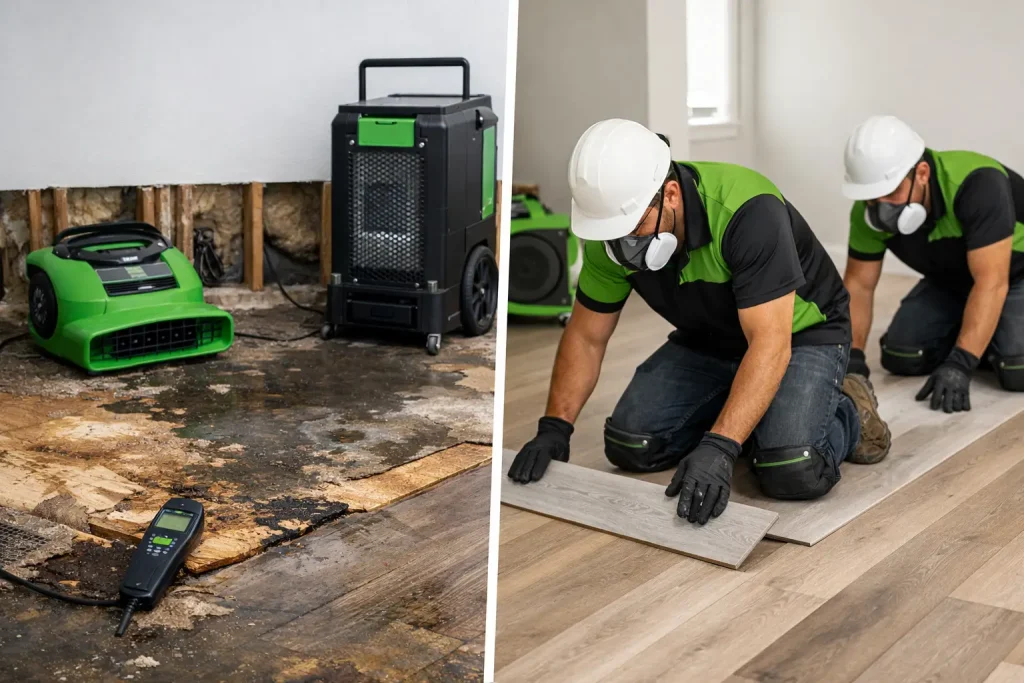
When you have already dealt with extraction, drying, and the disruption of a water loss, the last thing you want is to install a new floor that fails the next time moisture shows up. Choosing the best flooring after water damage is not just about appearance. It is about how the material handles moisture, how quickly it can be restored, and whether it fits the way the space is actually used.
That decision looks different in a kitchen than it does in a finished basement, and it looks different after a one-time plumbing leak than after a category of loss that involved prolonged saturation. The right flooring choice should match the cause of the damage, the condition of the subfloor, and the risk of future water exposure.
What matters most after a water loss
After water damage, many property owners focus on replacing what was there before. That is understandable, especially during an insurance-related reconstruction project. But flooring should be selected based on performance first.
The main question is not which floor is most attractive in a showroom. It is which material is least likely to swell, trap moisture, support microbial growth, or require another replacement if a similar event happens again. A floor that performs well after cleanup can help reduce future repair costs and shorten downtime if another incident occurs.
Moisture resistance is the first factor, but it is not the only one. You also need to consider whether the material can be installed over a properly dried and tested substrate, how it responds to humidity changes, and whether the space is above grade, below grade, or exposed to frequent spills. For commercial properties and multifamily buildings, maintenance demands and tenant turnover can matter just as much as water resistance.
Best flooring after water damage: the strongest options
Porcelain or ceramic tile
For many water-damaged areas, porcelain tile is the most dependable replacement option. It does not absorb water the way wood-based products do, it cleans well, and it performs reliably in kitchens, bathrooms, laundry rooms, and lower-level spaces. Ceramic tile can also work well, though porcelain is typically denser and more moisture resistant.
Tile is often the best fit when the goal is long-term durability. If a future leak occurs and the water is addressed quickly, the flooring itself is less likely to be ruined. That does not mean the entire assembly is immune to damage. Grout, setting materials, and the substrate below still need proper installation and drying. But compared to many other finishes, tile holds up exceptionally well.
The trade-off is that tile is harder underfoot and can feel cold. It also requires a stable subfloor. If the water damage affected the underlayment or structural components, those issues need to be corrected before installation.
Luxury vinyl plank and luxury vinyl tile
Luxury vinyl plank, often called LVP, and luxury vinyl tile are popular for a reason. High-quality products are highly water resistant, practical, and available in styles that resemble hardwood or stone. In homes and commercial properties where appearance matters but moisture risk remains a concern, vinyl is often one of the most balanced choices.
This can be one of the best flooring after water damage options when the area needs a cleaner look than tile but better water performance than laminate or engineered wood. It is especially useful in kitchens, entry areas, and many basement applications.
The key detail is that not all vinyl systems perform the same way. The plank itself may resist water, but moisture can still affect adhesives, seams, or the subfloor if the structure was not dried to acceptable levels before reconstruction. Product quality also matters. Lower-end materials may not wear as well in busy properties or commercial settings.
Sheet vinyl
Sheet vinyl does not always get the same attention as LVP, but in some cases it is the more practical option. Because it has fewer seams, it can limit water intrusion better than plank flooring when spills happen on the surface. That makes it a strong candidate for bathrooms, laundry rooms, and utility areas.
Its appearance may be less premium than tile or higher-end vinyl planks, but from a performance standpoint, sheet vinyl can be a smart choice in spaces where function comes first. For rental properties or budget-conscious rebuilds, it can provide solid moisture resistance at a more manageable cost.
Sealed concrete
In basements, utility rooms, and some commercial spaces, sealed concrete can be one of the most resilient options available. If the slab is structurally sound and moisture conditions are properly evaluated, a professional finish or coating can create a durable, low-maintenance surface.
This option makes sense where repeated moisture exposure is a realistic concern. It is less vulnerable to swelling, delamination, and hidden moisture issues than many traditional floor coverings. The downside is comfort. Concrete is hard, and depending on the finish, it may not provide the warmer look many homeowners want in living spaces.
Flooring materials that deserve caution
Hardwood
Solid hardwood is usually not the safest replacement after a water loss in moisture-prone areas. It is beautiful and long-lasting under normal conditions, but it is also vulnerable to cupping, warping, staining, and dimensional movement when exposed to water.
If the original damage involved a plumbing overflow, appliance leak, roof leak, or basement intrusion, reinstalling solid hardwood without addressing future moisture risk can lead to the same problem all over again. In dry, above-grade spaces with low risk and strong environmental control, hardwood may still be considered, but it should be a deliberate choice rather than the default.
Laminate
Laminate flooring has improved over time, and some products advertise water resistance. Even so, it is often a weak point after significant moisture exposure because its core can swell when water gets into the joints or edges. Once that happens, replacement is usually necessary.
For properties recovering from water damage, laminate can be risky in any area where future leaks or spills are possible. It may work in low-risk rooms, but there are usually better options if moisture resilience is the priority.
Carpet
Carpet is not usually the best answer after water damage, especially in basements or areas with a history of moisture problems. It can retain moisture, hold odors, and complicate cleaning if water intrudes again. Padding is particularly vulnerable.
That said, carpet is not always off the table. In upstairs bedrooms or low-risk living areas, some owners still prefer it for comfort. If carpet is chosen, the space should have a low chance of future water exposure and the structure below should be fully dried and restored first.
How to choose the best flooring after water damage for each area
The best material depends on where the damage occurred and how the space functions day to day. Bathrooms, laundry rooms, mudrooms, and lower-level spaces usually benefit most from tile, sheet vinyl, or quality LVP. These rooms see higher moisture exposure even under normal use.
Kitchens can go in a few directions. Tile offers excellent durability, while LVP gives you a softer and often more design-friendly finish. If the kitchen is part of an open floor plan and continuity matters, a high-quality vinyl product can provide a practical middle ground.
Finished basements require extra caution. Even if the immediate water event was fully mitigated, below-grade spaces naturally carry more moisture risk. That is why waterproof or highly water-resistant materials tend to make the most sense there. A floor that looks great but traps future moisture can turn into a costly problem.
Commercial spaces and multifamily properties often require a different lens. Fast turnaround, durability, easy cleaning, and predictable maintenance are usually more important than custom design details. In those environments, resilient flooring systems often outperform more delicate finishes.
The subfloor matters as much as the finish floor
A new floor is only as good as what is underneath it. After a water loss, the subfloor, underlayment, and surrounding materials must be evaluated carefully. Moisture testing, drying verification, and removal of unsalvageable materials are not optional steps. Installing over damp substrates can trap moisture and create failures that show up weeks or months later.
This is where professional restoration and reconstruction planning matters. Proper documentation, moisture mapping, and rebuild coordination help ensure the replacement floor is not covering unresolved damage. If the subfloor has been compromised, replacing the surface material alone will not solve the problem.
Insurance and replacement decisions
In insurance-related restoration projects, flooring decisions often involve both scope and practicality. Some policies may cover replacement based on like kind and quality, while others may allow for adjustments when matching materials are unavailable or when damage affects larger connected areas. The reconstruction plan should account for what was damaged, what can be restored, and what makes sense for the property going forward.
That is one reason many owners choose to upgrade to more moisture-tolerant flooring after a loss. If a previous material failed badly under water exposure, replacing it with something better suited to the environment can be a smart long-term move. The right contractor can help document the damage, coordinate with the claim process, and guide the rebuild toward a more durable result.
When property owners ask for the best flooring after water damage, the most accurate answer is usually not one product for every situation. It is the material that matches the moisture risk, the space, and the condition of the structure after proper mitigation. If your property is moving from drying and demolition into reconstruction, this is the moment to choose a floor that does more than look new. It should help the space recover stronger than before.
Every property and insurance policy is different. Contact Apollo to discuss the work your property may need; your insurer determines coverage.