A water leak behind a wall or smoke residue throughout a home cannot be evaluated by appearance alone. What looks dry may still hold damaging moisture, and what looks clean may still contain residue or odor sources. That is why IICRC restoration standards explained in practical terms matter to property owners: they establish a disciplined process for inspecting damage, documenting conditions, performing mitigation, and verifying that work is complete.
For homeowners, property managers, and commercial property owners, these standards provide a useful benchmark for asking the right questions after a loss. They also help create an organized record for the insurance restoration process. The right response still depends on the cause, scope, materials affected, building conditions, and policy coverage, but accepted industry standards give the work a clear technical foundation.
What Are IICRC Restoration Standards?
The Institute of Inspection, Cleaning and Restoration Certification, or IICRC, develops consensus-based standards and certification programs for the cleaning, inspection, and restoration industry. Its standards address how qualified professionals should assess, mitigate, clean, and document common property-loss conditions.
The standards are not a substitute for local building codes, environmental regulations, manufacturer instructions, or an insurance policy. They do not mean every damaged material can or should be saved. Instead, they help restoration teams make defensible decisions based on measurable conditions, safety requirements, and the characteristics of the affected structure.
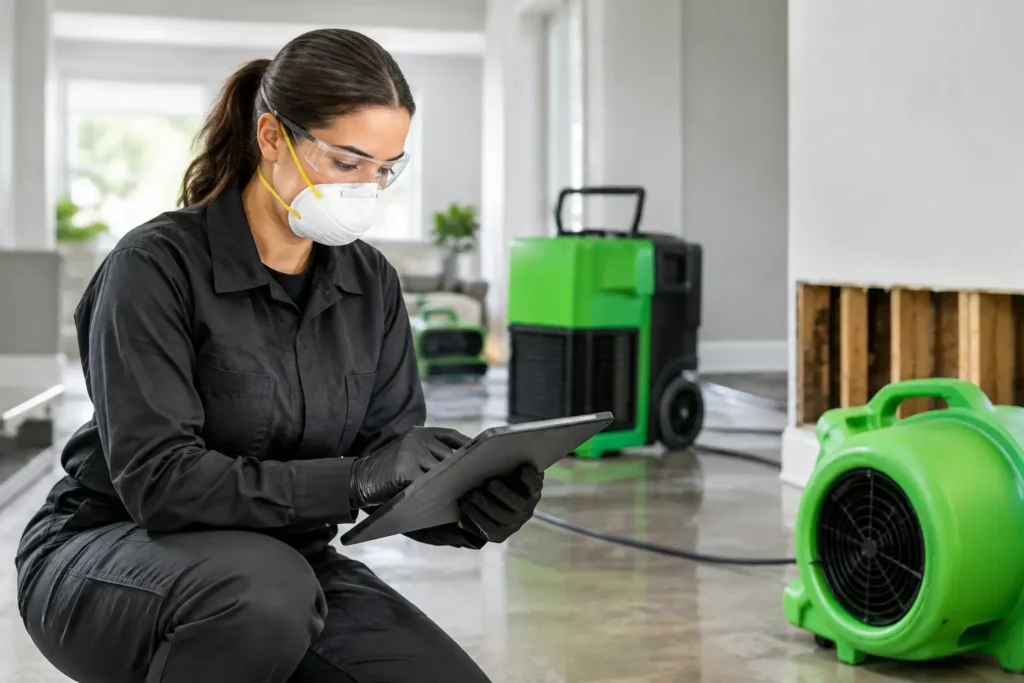
For example, a proper water-loss response is not simply placing fans in a wet room. It begins with finding the source, stopping further intrusion when possible, identifying the water condition, checking how far moisture traveled, determining which materials can be dried, and monitoring the structure until appropriate drying goals are met.
Why IICRC Restoration Standards Matter After Property Damage
Property damage becomes more expensive and disruptive when decisions are based on assumptions. Moisture can migrate beneath flooring, behind baseboards, and into insulation. Fire and smoke damage can affect surfaces far beyond the room where the event occurred. Mold concerns require careful containment and source correction, not surface treatment alone.
IICRC-based protocols bring consistency to these situations. They support clear documentation of initial conditions, the work performed, and progress throughout mitigation. That documentation can include moisture readings, thermal imaging observations, photographs, drying equipment records, cleaning logs, and final verification information.
This level of organization benefits everyone involved. Property owners gain visibility into what happened and why certain work is necessary. Adjusters and carriers receive condition-based documentation to review. Restoration teams have a defined process for coordinating mitigation with reconstruction, reducing the risk that repairs begin before the underlying loss is properly addressed.
Key IICRC Standards Property Owners May Encounter
Not every loss calls for every standard. A burst supply line, kitchen fire, roof leak, and suspected mold condition all require different scopes of work. However, several IICRC standards are frequently relevant during residential and commercial restoration.
ANSI/IICRC S500 for Water Damage Restoration
The S500 is the primary standard for professional water damage restoration. It addresses assessment, water extraction, drying, monitoring, documentation, and safety considerations. It also helps professionals classify water intrusion based on contamination risk and determine the extent of damage to materials and assemblies.
One practical principle is that drying requires measurement. A qualified team compares moisture levels in affected materials with appropriate dry standards or unaffected areas, then adjusts equipment and procedures as conditions change. Visual dryness alone is not a reliable completion standard.
The S500 also recognizes that some situations require more than drying. Porous materials exposed to contaminated water, materials that cannot be effectively dried, and building components affected by long-term moisture may need removal. The appropriate approach depends on the conditions found during inspection.
ANSI/IICRC S520 for Professional Mold Remediation
The S520 provides guidance for mold remediation work, including project assessment, containment, source correction, removal methods, cleaning, and post-remediation considerations. A central idea is simple: remediation must address the moisture condition that allowed mold growth in the first place.
Painting over staining or applying a surface treatment without fixing a roof leak, plumbing issue, condensation problem, or drainage failure does not resolve the underlying concern. Depending on the scope, remediation may require containment barriers, air management, controlled removal of affected materials, and detailed cleaning to limit cross-contamination.
Mold projects vary significantly. A small, isolated issue may require a focused repair, while extensive hidden damage can call for a larger, carefully controlled scope. Professionals should evaluate the affected area, building materials, and moisture source before recommending the work plan.
ANSI/IICRC S700 for Fire and Smoke Damage Restoration
Fire restoration is not limited to debris removal and repainting. The S700 addresses inspection, safety, corrosion control, odor management, cleaning methods, and restoration planning after fire and smoke damage.
Smoke behavior varies by fuel source, heat, airflow, and the building layout. Residues can settle on walls, contents, HVAC components, and concealed surfaces. Using the wrong cleaning method can spread residues or damage finishes. A standards-based approach evaluates the type and distribution of residues before selecting cleaning procedures and determining what can be restored.
Odor work follows the same logic. The odor source must be identified and removed or properly cleaned before deodorization methods can be effective. Covering an odor temporarily is not the same as restoring the affected environment.
Other Standards That Can Affect the Project
Depending on the loss, professionals may also apply guidance related to professional cleaning, trauma and crime scene cleanup, or inspection practices. In addition, asbestos-containing materials, lead-based paint, structural damage, electrical hazards, and contaminated sewage conditions may trigger separate regulations, testing, licensed trades, or specialized safety procedures.
A reliable restoration plan accounts for these overlaps early. This prevents a reconstruction schedule from moving ahead before environmental, safety, or moisture-related concerns are resolved.
What IICRC-Based Work Looks Like on the Job
A property owner should expect a restoration contractor to explain the process in plain language. The work often begins with emergency stabilization, such as stopping active water intrusion, protecting undamaged contents, securing an exposed roof area, or addressing immediate safety hazards.
Next comes a detailed inspection. Technicians may use moisture meters, thermal imaging, hygrometers, photographs, and 360-degree imaging to identify the scope of damage. These tools assist the inspection, but they do not replace professional judgment. Thermal imaging, for example, can identify temperature differences that may indicate moisture, while meter readings help confirm actual material conditions.
The mitigation phase may include extraction, controlled demolition, structural drying, HEPA vacuuming, contents pack-out, cleaning, or containment. Throughout the process, technicians should monitor progress and record conditions rather than assume equipment can be removed after a fixed number of days.
Once mitigation is complete, reconstruction can begin with a clearer understanding of what must be repaired or replaced. This is where a full-service restoration partner can reduce coordination gaps between emergency response, documentation, insurance communication, and final construction.
Questions to Ask a Restoration Contractor
When a loss occurs, urgency matters, but so does clarity. Ask how the source of damage will be identified and corrected, how affected areas will be measured and documented, and what criteria will be used to determine that drying or cleaning is complete.
You should also ask which materials can be restored versus removed, how the team will protect unaffected areas, and how the work will be communicated to your insurance carrier or adjuster. If the project involves mold, sewage, asbestos, or structural concerns, ask what additional safety controls or qualified specialists are needed.
Be cautious of anyone who promises an exact scope before inspecting the property or guarantees insurance coverage. A responsible contractor can explain the observed conditions, provide organized documentation, and work within the facts of the loss. Coverage decisions remain with the insurer under the terms of the policy.
IICRC Restoration Standards Explained: The Practical Takeaway
IICRC standards help turn a chaotic property loss into a documented, measurable recovery process. They guide how professionals evaluate damage, protect occupants and workers, select mitigation methods, monitor results, and prepare a property for proper repairs.
For property owners in Maryland, Northern Virginia, Washington DC, and Pennsylvania, Apollo Construction & Renovation Corp. applies IICRC-based restoration protocols alongside detailed documentation, safety-focused practices, and coordinated reconstruction support. If your property has active water, fire, smoke, storm, or mold-related damage, act quickly to prevent conditions from spreading – then choose a team prepared to explain every step and document the work from mitigation through rebuilding.
Every property and insurance policy is different. Contact Apollo to discuss the work your property may need; your insurer determines coverage.