
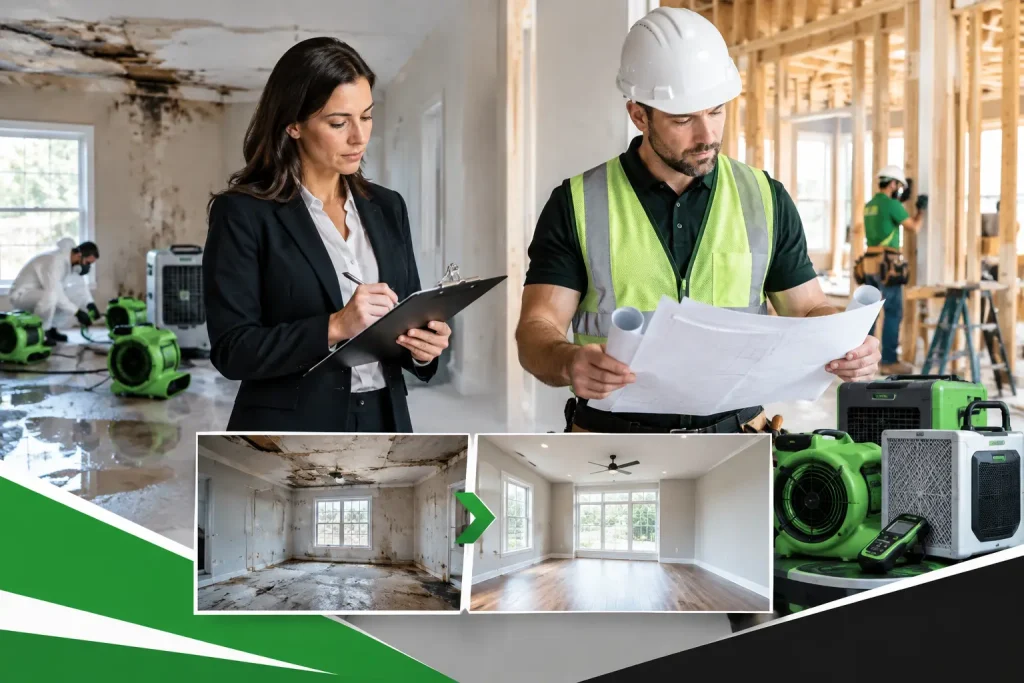
A burst pipe behind a wall, a wind-damaged roof, or smoke contamination after a fire creates two urgent needs: protect the property and understand the insurance claim. The public adjuster vs contractor question matters because these professionals have different responsibilities, different compensation structures, and different roles in your recovery.
Choosing the right help should not delay emergency mitigation. Water can continue moving through flooring, drywall, insulation, and framing long after the visible leak stops. A qualified restoration contractor can stabilize conditions, document damage, and begin appropriate mitigation while the claim moves forward.
Public Adjuster vs Contractor: The Core Difference
A public adjuster is a licensed insurance claims professional who represents the policyholder. Their role is to review the policy, assess the loss, prepare or support the claim presentation, and negotiate with the insurance carrier on the property owner’s behalf. Public adjusters generally charge a fee based on a percentage of the insurance settlement, subject to applicable state rules and contract terms.
A contractor performs the physical work needed to protect, restore, and rebuild the property. That can include emergency water extraction, drying, debris removal, smoke cleaning, roofing repairs, mold remediation, electrical and plumbing repairs, drywall replacement, flooring, painting, and full reconstruction. The contractor is paid for the approved scope of work and materials, not for negotiating the settlement.
Both may inspect the same damage, create documentation, and communicate with the insurer. But their responsibilities are not interchangeable. A public adjuster advocates for the policyholder’s claim. A restoration contractor establishes what it will take to safely and properly return the property to its pre-loss condition.
What a Public Adjuster Can Do for a Property Owner
A public adjuster can be useful when a claim is complex, the damage is extensive, or the property owner needs dedicated representation during settlement discussions. This may apply after a large fire, widespread water damage, a major storm event, or a commercial loss with business interruption concerns.
Their work often includes reviewing policy provisions, organizing inventories and loss documentation, preparing estimates or claim submissions, attending inspections, and negotiating the value of covered damage. They may also help identify areas of damage that need further evaluation, such as hidden moisture, damaged contents, code-related repair issues, or portions of the structure that were overlooked during an initial inspection.
A public adjuster does not typically provide emergency services or manage the actual reconstruction. Even when a public adjuster is involved, you still need qualified mitigation and construction professionals to perform the work, document job conditions, and provide repair scopes based on the building’s actual needs.
Before hiring a public adjuster, ask how fees are calculated, what services are included, whether there are cancellation terms, and how often you will receive updates. Licensing requirements and permitted activities vary by state, so confirm that the adjuster is properly licensed for the state where the loss occurred.
What a Restoration Contractor Does After a Loss
A full-service restoration contractor focuses first on preventing additional damage and then on restoring the property correctly. After a water loss, that may mean extracting water, setting drying equipment, taking moisture readings, creating moisture maps, and removing materials that cannot be safely dried. After a fire, it may involve securing the structure, evaluating smoke and soot impact, cleaning affected areas and contents, and preparing a reconstruction plan.
The contractor’s documentation can be critical to the claim process. Photos, thermal imaging, 360-degree imaging, daily drying records, moisture readings, material inventories, and detailed estimates help show what was damaged, why specific work was necessary, and how the restoration process progressed.
A knowledgeable contractor can also meet with the carrier’s field adjuster, explain findings, answer construction questions, and revise an estimate when new damage is discovered during approved work. That support is valuable, but it is different from acting as your claims representative or interpreting what your policy should cover.
At Apollo Construction & Renovation Corp., the restoration process is built around IICRC-based mitigation practices, detailed project documentation, and coordinated reconstruction. For property owners, that means fewer gaps between emergency response, insurer inspection, repair planning, and final completion.
When You May Need Both
For many straightforward claims, a capable restoration contractor and clear communication with the insurance carrier are enough. A small, contained water loss with prompt mitigation and a well-defined repair scope may not require a public adjuster.
There are situations, however, where using both professionals can make sense. A public adjuster may manage claim advocacy while the contractor focuses on evidence, mitigation, repair pricing, and craftsmanship. This arrangement can be helpful when the loss has multiple causes, involves extensive hidden damage, affects a large commercial property, or requires substantial reconstruction across several building systems.
The relationship works best when everyone understands the boundaries. The contractor should provide accurate, supportable documentation and perform work according to the approved scope. The public adjuster should handle policyholder representation and settlement discussions. The property owner should remain informed, review agreements carefully, and approve major decisions.
Do Not Wait for a Claim Decision Before Mitigation
One of the most costly mistakes after property damage is waiting too long to address an active threat. Water intrusion, roof openings, sewage backups, and fire-related exposure can worsen quickly. Secondary damage may include mold growth, warped materials, corrosion, compromised insulation, or further damage to adjacent rooms.
Reasonable emergency measures are often necessary to protect the property from additional damage, but every situation is different. Document conditions before work begins when it is safe to do so, keep invoices and records, and report the loss to your insurer promptly. A professional mitigation contractor can document the emergency work with photographs, readings, equipment logs, and a clear explanation of the actions taken.
Avoid authorizing broad reconstruction based only on a verbal promise of coverage. A careful contractor will distinguish between emergency stabilization, which may need to begin immediately, and larger repair decisions that should be coordinated with the insurer and property owner.
Questions to Ask Before You Hire Anyone
Whether you are speaking with a public adjuster, a contractor, or both, clarity at the beginning protects the project later. Ask who will be your main point of contact, what documentation you will receive, how pricing is developed, and how changes discovered during work will be handled.
For a public adjuster, ask about licensing, fee percentage, contract length, and whether the agreement applies to supplemental payments received later. For a contractor, ask about restoration credentials, insurance coverage, safety practices, emergency procedures, project scheduling, and who will manage the work from mitigation through reconstruction.
It is also reasonable to ask how the contractor supports insurance documentation. A contractor should be able to explain its findings in plain language and provide detailed records without making promises about final coverage or settlement amounts. The carrier makes coverage determinations under the policy, while the contractor provides the factual and technical basis for the work it recommends.
Making the Right Call After Property Damage
The best choice depends on the severity of the loss, the complexity of the claim, your comfort managing insurance communications, and the quality of the restoration documentation available. A public adjuster can provide dedicated policyholder representation. A contractor provides the hands-on expertise needed to stop damage, establish a reliable scope, and rebuild the property safely.
If your property has active water, storm, fire, smoke, or mold-related damage, prioritize stabilization and documentation first. Then choose the claims support and construction team that gives you clear communication, transparent records, and a practical path from emergency conditions to a fully restored property.
Every property and insurance policy is different. Contact Apollo to discuss the work your property may need; your insurer determines coverage.