
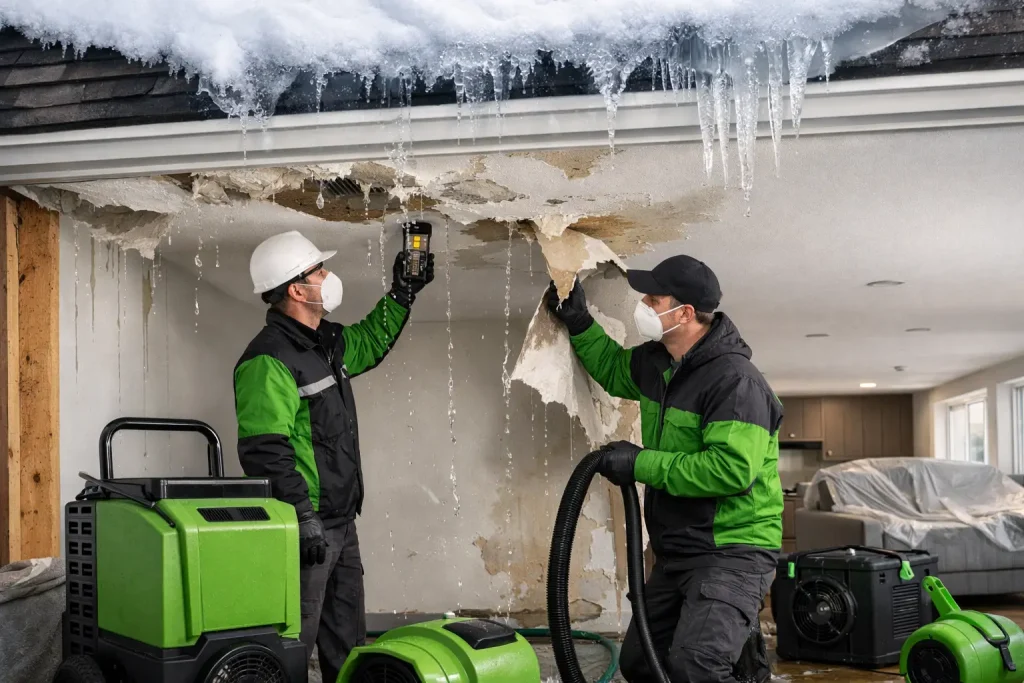
A ceiling stain that appears after a snowstorm usually catches people off guard. The roof may look intact from the ground, but water can still work its way under shingles, into insulation, and down interior walls. If you are wondering what causes ice dam leaks, the short answer is uneven roof temperatures, melting snow, and trapped water that has nowhere safe to drain.
Ice dam leaks are common in winter, especially after cycles of snowfall, daytime melting, and overnight freezing. They can affect older homes, newer homes, multifamily properties, and commercial buildings alike. The leak itself is rarely the first problem. By the time water shows up indoors, the roof system has already been under stress.
What Causes Ice Dam Leaks on a Roof?
Ice dams form when heat escapes from the building and warms sections of the roof deck. Snow on those warmer sections melts and runs downward toward the colder roof edge, usually near the eaves. Because the eaves stay colder, that meltwater refreezes there and starts building a ridge of ice.
Once that ridge grows, it acts like a barrier. New meltwater from higher up on the roof cannot drain off normally, so it pools behind the ice dam. Shingles are designed to shed water flowing downward, not to hold standing water. When water backs up, it can slip beneath shingles, pass through underlayment weaknesses or flashing details, and enter the structure.
That is why the leak often appears several feet away from the actual ice dam. Water can travel along roof decking, rafters, insulation, and wall cavities before it becomes visible on a ceiling or around a window frame.
The Conditions That Create Ice Dams
The main driver is heat loss from inside the property. Warm air rises, and if the attic floor is poorly air sealed or under-insulated, that heat warms the underside of the roof. Recessed lights, attic hatches, plumbing penetrations, duct leaks, and bath fan exhaust issues can all contribute.
Ventilation also matters, but it is not the whole story. Proper attic ventilation helps maintain a more consistent roof temperature, yet ventilation alone will not overcome major insulation gaps or significant air leakage. In many buildings, ice dams happen because several small defects are working together rather than one obvious failure.
Weather patterns add another layer. A heavy snowfall followed by sun exposure or a brief warm-up can start rapid melting. Then a hard freeze overnight locks water at the edge of the roof. North-facing slopes, shaded areas, valleys, and lower roof sections near dormers can behave differently than sunny roof planes, so ice dams do not always form evenly.
Why Gutters Are Sometimes Involved
Gutters do not usually cause the ice dam by themselves, but they can make the situation worse. If gutters are clogged with debris or already packed with ice, drainage slows down even more at the roof edge. That can help ice build faster and hold more backed-up water.
Even so, removing or replacing gutters is not the universal fix. On some homes, attic heat loss is the primary issue. On others, roof geometry and winter weather exposure play a larger role. A proper inspection should look at the entire system, not just one component.
Why Ice Dam Leaks Can Be More Serious Than They Look
Many property owners first notice a small water spot and assume the damage is minor. In reality, ice dam leaks often affect more than the visible area. Wet insulation loses performance, which can make the roof colder in some places and warmer in others, feeding the same cycle. Moisture can also damage drywall, trim, framing, flooring, and electrical fixtures.
If water remains trapped, mold growth can begin in concealed spaces. For commercial properties and multifamily buildings, that can mean disruption across multiple units or tenant areas. For homeowners, it can turn a winter roof issue into a larger restoration project involving drying, insulation replacement, interior repairs, and documentation for an insurance claim, depending on the policy and cause of loss.
Common Building Issues Behind Ice Dam Leaks
Insufficient attic insulation
When insulation levels are too low or uneven, indoor heat transfers upward more easily. This creates warm spots on the roof deck that melt snow prematurely.
Air leaks from the living space
Even a well-insulated attic can underperform if warm air is escaping through gaps. Areas around light fixtures, wall tops, plumbing penetrations, chimneys, and attic access points are common trouble spots.
Poor attic ventilation
Without balanced intake and exhaust ventilation, the attic may not stay close to outside temperatures. That temperature imbalance can increase snow melt on the roof.
Roof design complications
Valleys, dormers, skylights, low-slope transitions, and intersecting rooflines often create pockets where snow and ice linger. These details are more vulnerable if flashing or underlayment is aging.
Freeze-thaw weather cycles
A roof can perform reasonably well in steady cold conditions but still develop ice dams during repeated warming and refreezing. That is why some winters are much worse than others.
Signs You May Have an Ice Dam Leak
Not every winter leak is visible as dripping water. Sometimes the early warning signs are subtler. You might see icicles along the eaves, uneven snow melt patterns on the roof, frost in the attic, peeling paint near exterior walls, damp insulation, or staining around ceiling edges.
If you notice water entering around windows, exterior walls, or light fixtures after snow accumulation, do not assume the problem is isolated to that exact location. Water migration can make the source harder to trace without a thorough moisture inspection.
What to Do If You Suspect an Ice Dam Leak
Start by protecting the interior. Move contents away from affected areas if it is safe to do so, place containers under active drips, and document visible damage with photos. If water is near light fixtures, outlets, or electrical panels, use caution and contact qualified professionals immediately.
Avoid unsafe DIY roof work during icy conditions. Climbing onto a snow-covered roof or trying to chip away ice can damage roofing materials and create serious fall hazards. Temporary response may include controlled snow removal from the roof edge by trained crews, but the right approach depends on the amount of ice, roof type, and current weather.
This is also where fast mitigation matters. Once water enters the building envelope, drying and moisture mapping can help limit secondary damage. A restoration contractor with roofing and interior repair experience can assess both the exterior cause and the interior impact instead of treating them as separate problems.
How to Prevent Future Ice Dam Leaks
Preventing recurrence usually requires more than one correction. The goal is to keep the roof surface temperature as consistent as possible and allow meltwater to drain before it refreezes at the edge.
Air sealing the attic floor is often one of the most effective upgrades because it reduces the flow of warm interior air into the attic. Adding or correcting insulation helps maintain a stronger thermal boundary. Ventilation improvements may also be needed, especially when intake or exhaust pathways are blocked or poorly designed.
In some cases, roofing upgrades are part of the solution. During roof replacement or repair, details such as underlayment at eaves, flashing, drainage components, and vulnerable transitions should be evaluated carefully. There is no single fix that works for every property, and that is why inspection matters.
For property owners in Maryland, Northern Virginia, Washington DC, Delaware, and Pennsylvania, winter conditions can shift quickly. Buildings in this region often see the exact mix of snowfall, partial thaw, and overnight refreeze that leads to ice dam activity. A proactive inspection before or after winter can identify insulation issues, ventilation problems, and roof vulnerabilities before they result in interior water damage.
When It Is Time to Call a Professional
If water is already entering the property, if the roof edge is heavily iced over, or if staining continues after snow events, it is time for a professional assessment. The right team should evaluate roof conditions, attic performance, moisture intrusion, and any affected interior materials. In insurance-related loss situations, accurate documentation is also important.
Apollo Construction & Renovation Corp. approaches winter leak events the same way it handles any property damage issue – with urgency, clear communication, and a full-scope view of mitigation and repair. That matters because stopping visible water is only part of the job. The real objective is protecting the structure, documenting the loss properly, and addressing the building conditions that allowed the ice dam leak to happen.
A winter leak is rarely just bad luck. It is usually a signal that heat, moisture, and drainage are not working together the way they should. Catching that signal early can save significant repair time, interior disruption, and long-term roof damage.
Every property and insurance policy is different. Contact Apollo to discuss the work your property may need; your insurer determines coverage.