
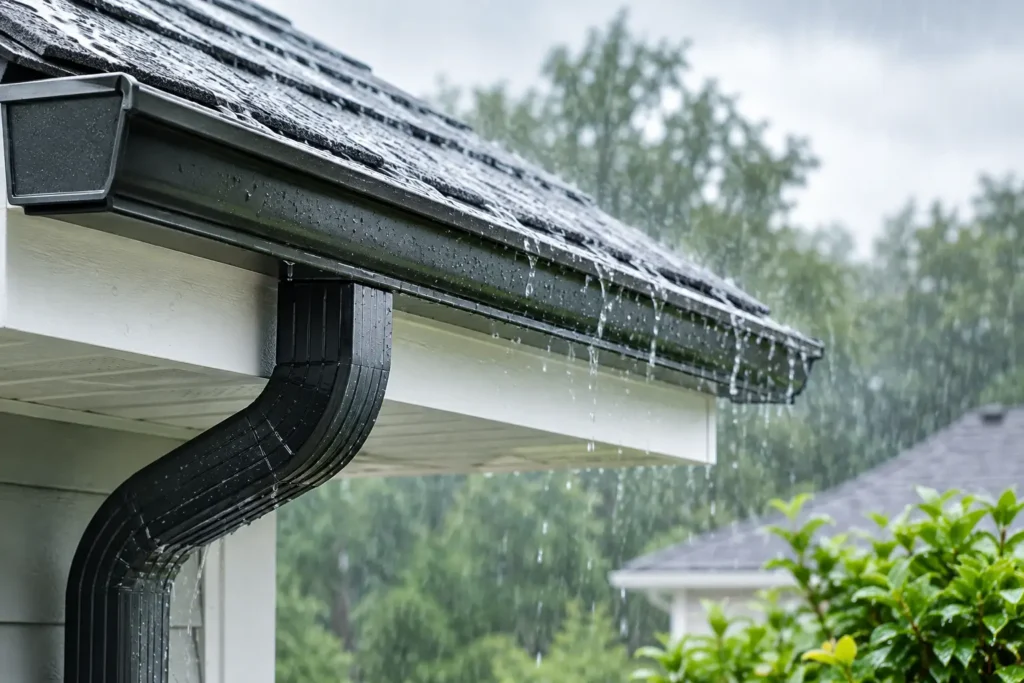
A gutter can look perfectly serviceable on a dry afternoon and still fail during the first hard downpour. Water spilling over the front edge, running behind the fascia, or pooling beside the foundation is usually a capacity or installation problem, not just a maintenance issue. The best gutters for heavy rain move roof runoff quickly, stay securely attached under load, and discharge water far enough from the building to protect the roofline, siding, foundation, and interior.
For homes and commercial properties in the Mid-Atlantic, gutter selection should account for intense summer storms, wind-driven rain, falling leaves, snow, and freeze-thaw conditions. A larger or stronger system costs more upfront, but it can prevent the repeated overflow and water intrusion that lead to damaged trim, saturated insulation, stained ceilings, basement leaks, and mold concerns.
What Makes Gutters Work in Heavy Rain?
A gutter system is only as effective as its weakest component. The trough must capture runoff, the outlets and downspouts must carry it away without backing up, and the mounting system must hold its slope when the gutter is full of water. If any one of those pieces is undersized or poorly installed, even premium materials can underperform.
Roof area and roof shape matter more than many property owners realize. A steep roof sheds water faster than a low-slope roof. A long roof valley concentrates runoff into one short section of gutter. Large roofs, metal roofs, and roofs with multiple valleys can create a sudden volume of water that overwhelms a standard system during a fast-moving storm.
Rainfall intensity also matters. A gutter sized for ordinary rain may overflow in a cloudburst. That is why a qualified contractor should assess the roof’s drainage layout rather than recommending one gutter size for every property.
Best Gutters for Heavy Rain: Size Comes First
For many residential properties, 6-inch K-style gutters are the most practical choice for heavy rainfall. They carry substantially more water than common 5-inch systems while maintaining a familiar appearance along the roofline. When paired with properly sized downspouts, they are often the right upgrade for homes that experience routine overflow during storms.
Seven-inch gutters may be appropriate for larger roofs, steep roof planes, commercial buildings, or roof sections where valleys send concentrated water into one area. They are more visible and typically cost more, but their added capacity can be justified when a 6-inch system would still be close to its limit.
K-style gutters are popular because their profile holds more water than similarly sized half-round gutters. They also fit many architectural styles and can be formed as seamless runs, reducing the number of joints that may eventually leak. Half-round gutters can work well on historic or traditional homes, but they often need a larger diameter to provide comparable drainage capacity.
The downspouts must match the gutter’s capacity. A large gutter with too few outlets can still overflow at valleys and corners because water cannot exit fast enough. For heavy rain applications, oversized rectangular downspouts are frequently a better choice than smaller standard downspouts. The correct number and placement depend on roof drainage, not simply the building’s perimeter.
Pay Attention to Valleys and Long Runs
Roof valleys deserve special attention. They collect runoff from two roof planes and release it in a concentrated stream, often with enough force to jump over or overshoot a shallow gutter. A wider gutter, a valley splash guard, adjusted outlet placement, or a combination of these measures may be necessary.
Long gutter runs can also create problems. Water has farther to travel before reaching a downspout, and debris tends to settle near the outlet. Strategic placement of additional downspouts can improve flow and reduce the volume handled by any single section.
Choose Materials That Can Carry the Load
Material selection affects longevity, maintenance needs, and how well gutters tolerate heavy water loads, wind, and seasonal weather changes.
Aluminum is the most common choice for residential gutter systems, and for good reason. It resists rust, is available in many colors, and works well for seamless fabrication. A heavier-gauge aluminum gutter is preferable for heavy rain areas because thinner material can dent, flex, or hold water if it loses its slope.
Galvanized steel is stronger than aluminum and can be a practical choice where impact resistance is a priority. However, its protective coating can wear over time, creating a risk of rust if maintenance is neglected. It is usually best suited to situations where its added strength outweighs the need for periodic inspection and repainting.
Copper offers excellent durability and a distinctive appearance, but it comes at a significantly higher price. It is generally selected for architectural reasons and can serve well when installed with compatible fasteners and components. Copper is not automatically the best value for every property facing heavy rain.
Vinyl gutters are inexpensive and resist corrosion, but they are usually not the first recommendation for demanding weather conditions. They can become brittle in cold temperatures, warp with heat exposure, and sag when carrying substantial water or debris loads. For a property that has already experienced gutter overflow or storm-related drainage issues, a professionally installed metal system is usually the more dependable investment.
Installation Details Matter as Much as the Gutter
The best gutter material will not solve a drainage problem if the system is pitched incorrectly, loosely fastened, or discharging beside the foundation. Gutters need a consistent, subtle slope toward each downspout. Too little slope allows standing water and sediment buildup. Too much slope can be visibly unattractive and may leave one end too low to capture runoff effectively.
Heavy-duty hidden hangers and properly spaced fasteners help prevent sagging. This is especially important where wet leaves, ice, or snow can add weight to the system. Fasteners should be secured into sound framing, not weakened or water-damaged fascia material. If the fascia has rot or the roof edge is compromised, those conditions should be corrected before installing new gutters.
Flashing and drip edge placement also affect performance. Water should enter the gutter, not travel behind it. When water runs behind the gutter, it can damage fascia boards, soffits, exterior walls, and insulation before the issue becomes visible indoors.
Downspouts should release water well away from the foundation through extensions, properly designed drainage components, or an appropriate site-specific drainage solution. Simply adding a larger gutter does little good if runoff lands next to the building and saturates the soil around the basement or crawl space.
Do Gutter Guards Help During Heavy Rain?
Gutter guards can reduce the frequency of cleaning, but they are not a substitute for correct gutter sizing or maintenance. Their performance depends on the guard design, the surrounding trees, roof debris, and the volume of runoff. Some guards may shed leaves effectively but allow fine debris to collect inside. Others can struggle when a roof valley sends a high-speed sheet of water across the surface.
A well-chosen guard may be useful for properties with recurring leaf buildup, particularly when paired with oversized gutters and adequate downspouts. However, every system still needs inspection after severe storms and during seasonal maintenance. Debris can collect at outlets, behind guards, and in downspout elbows even when the gutter channel appears clean from the ground.
Signs Your Current Gutters Are Undersized
Overflow during a light rain can point to a clog, but overflow only during heavy storms often signals a capacity issue. Watch for water pouring over the front edge, streaking down siding, washing out mulch, or collecting along the foundation. Other warning signs include gutter sections that pull away from the fascia, standing water after rain, peeling exterior paint, and recurring dampness near upper-level ceilings or walls.
Do not assume the gutter is the only source of the problem. Damaged shingles, failed flashing, blocked roof valleys, and deteriorated fascia can all direct water where it does not belong. A full exterior inspection helps identify whether the solution is gutter replacement, roof repair, drainage correction, or coordinated work across several components.
When storm runoff has already entered the property, prompt mitigation is critical. Apollo Construction & Renovation Corp. helps property owners assess water intrusion, document damage, address moisture concerns, and coordinate the repairs needed to restore the building envelope.
A well-designed gutter system is quiet when it is working correctly: water enters, drains, and moves away without drawing attention. Before the next major storm, have the roofline, gutters, downspouts, and drainage path evaluated together. That preparation can protect far more than the edge of the roof.
Every property and insurance policy is different. Contact Apollo to discuss the work your property may need; your insurer determines coverage.