
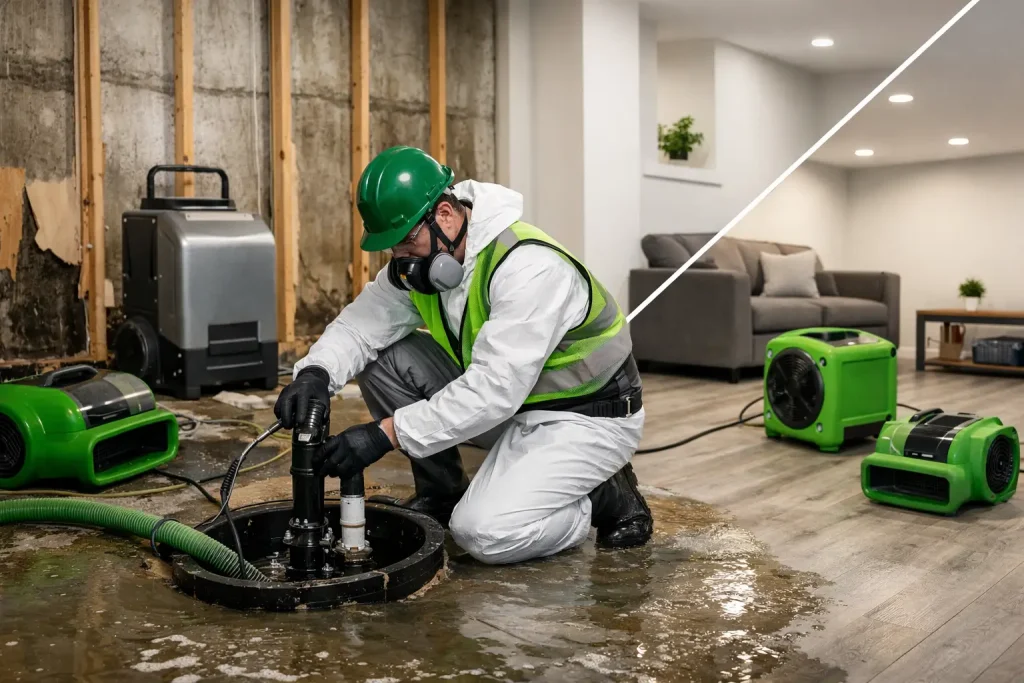
A basement usually gives you warning before it gives you trouble. You may notice a damp odor, a ring of moisture along the wall, or a sump pit that seems to run harder than usual after heavy rain. That is often where flood and sump pump problems begin – not with dramatic water intrusion, but with small signs that the system protecting your property is under stress.
For homeowners and property managers, the real issue is not just whether a pump turns on. It is whether the whole drainage and pumping system can keep up when the weather shifts, groundwater rises, or a discharge line freezes, clogs, or fails. When it cannot, water moves quickly into finished spaces, storage areas, mechanical rooms, and lower-level wall cavities. That is when a preventable maintenance issue becomes a mitigation and reconstruction project.
How flood and sump pump systems work together
A sump pump is designed to remove groundwater that collects in a sump basin, typically located in the lowest part of a basement or crawl space. Its job is straightforward – detect rising water in the pit and push it away from the structure through a discharge line. In many properties, that system is one of the first lines of defense against basement flooding.
The challenge is that a pump does not work in isolation. Performance depends on grading around the building, footing drains, drain tile condition, the discharge route, electrical reliability, and the amount of water entering the system at one time. If one piece of that chain fails, the pump can become overwhelmed or useless even if the motor itself is still functional.
This is why flood events tied to sump systems often surprise property owners. The pump may have worked during normal rain, then fail during a major storm because demand spikes, power is lost, or debris blocks movement inside the pit. In commercial and multi-unit properties, the consequences can spread fast if water reaches shared walls, utility spaces, elevators, inventory, or tenant finishes.
Why sump pump failures lead to bigger losses
Water in a basement is rarely a one-layer problem. The visible standing water is only part of the loss. Moisture wicks into drywall, base trim, insulation, framing, flooring, and contents. If the water sits too long, indoor humidity climbs and secondary damage follows.
That is why response time matters. The first 24 to 48 hours often determine whether a project remains a controlled drying job or becomes a more extensive restoration involving demolition, antimicrobial treatment, contents handling, and reconstruction. If the water source is groundwater or storm-related intrusion, there can also be contamination concerns depending on what the water contacted before entering the building.
A failed sump system can also affect more than one insurance question. Property owners may need clear documentation of the source, the extent of affected materials, moisture readings, and the sequence of mitigation work. Organized reporting helps reduce confusion and supports a cleaner recovery process.
Common flood and sump pump warning signs
Most failing systems give some notice. The warning signs are not always dramatic, but they should not be ignored.
A pump that runs constantly may be undersized, improperly installed, or dealing with excessive groundwater. A pump that cycles on and off too frequently may have a float issue or a pit that is too small. Unusual noises can point to worn bearings, debris in the impeller, or a struggling motor. If the discharge line sends water back toward the foundation, the system may be functioning mechanically while still failing the property.
Other signs are easier to miss. Efflorescence on basement walls, recurring damp carpet edges, rust at metal studs or mechanical equipment, and musty odors near finished lower levels often indicate chronic moisture movement. In a crawl space, cupped insulation, soft wood components, or persistent condensation can tell a similar story.
What to do when the sump pump fails and water is rising
If water is actively entering the property, speed matters more than guesswork. Start by protecting people first. Avoid contact with standing water around electrical systems or outlets, and do not attempt unsafe electrical work. If the area can be accessed safely, remove vulnerable contents and move them to a dry location.
Then focus on limiting spread. Shut off the water source if the issue is tied to plumbing rather than groundwater. If the event is storm-driven or due to pump failure, document visible conditions with photos and video as soon as it is safe to do so. That early record can help establish the cause and scope of damage.
Professional mitigation should begin as quickly as possible. Extraction, moisture mapping, thermal imaging, controlled demolition where needed, and commercial drying equipment all play a role in preventing hidden saturation from becoming a much larger repair. A qualified restoration contractor can also identify whether the loss is limited to floor-level materials or has extended into wall cavities, insulation, cabinetry, or structural components.
When repair is enough and when full mitigation is needed
It depends on how much water entered, how long it remained, and what materials were affected. A simple sump pump replacement may solve the immediate mechanical failure, but it does not address wet drywall, soaked insulation, compromised flooring, or elevated humidity in enclosed spaces.
This is where property owners sometimes lose valuable time. Replacing the pump alone can create the impression that the emergency is over, even though moisture remains trapped behind finishes. Days later, odors develop, materials swell, and visible staining appears.
A proper evaluation looks beyond the equipment. It asks whether water migrated under flooring, into adjoining rooms, behind baseboards, or into lower sections of framing. It also considers whether sewage, stormwater, or groundwater contamination changes the cleanup protocol. The right scope of work is not always the biggest one – it is the one supported by actual site conditions and moisture data.
Preventing the next flood and sump pump emergency
No system can eliminate all risk, especially during extreme weather, but good prevention lowers the odds of a serious loss. Regular testing matters. So does cleaning the pit, checking the float mechanism, inspecting the discharge line, and confirming that water is being carried far enough away from the building.
Backup power is worth serious consideration in areas where storms commonly interrupt electricity. A battery backup or secondary pump can provide critical protection when the primary system fails under peak demand. Property owners should also look at the exterior conditions feeding the problem. Poor grading, clogged gutters, short downspouts, and foundation drainage issues can overload even a functioning sump system.
For finished basements and lower-level commercial areas, prevention should include a plan for rapid response. Know where the sump pit is, who is responsible for maintenance, and who to call if water intrusion starts after hours. In managed properties, those details should be documented before a storm, not during one.
Why professional documentation matters after a loss
A water emergency is stressful enough without uncertainty around cause, scope, and next steps. Detailed documentation helps everyone involved make decisions faster. Moisture readings, room-by-room impact notes, photos, thermal imaging, and drying logs create a clear record of what was affected and how the property is being stabilized.
For insurance-related restoration, that level of organization is especially important. It supports communication with adjusters, helps separate emergency mitigation from reconstruction needs, and reduces the chance of avoidable disputes over what was wet, what was removed, and why certain drying methods were used.
This is one reason many property owners choose a contractor that can handle both emergency response and rebuilding. The handoff between mitigation and reconstruction is smoother when the same team understands the original damage path, the drying record, and the repair scope from the beginning.
A practical approach to basement water risk
The safest assumption is that if your sump pump has already struggled once, it can struggle again under the right conditions. That does not mean panic. It means taking the warning seriously, inspecting the full system, and correcting the conditions that allow groundwater to win.
At Apollo Construction & Renovation Corp., that practical approach is how water losses are contained before they grow into larger restoration problems. Whether the issue starts with one failed pump, recurring seepage, or a storm-driven basement flood, the goal is the same – stop the damage, document it clearly, dry the structure properly, and move the property back toward full recovery with as little disruption as possible.
If your basement smells damp, your sump system is cycling abnormally, or water has already entered the space, act before hidden moisture turns a manageable issue into a much larger repair.
Every property and insurance policy is different. Contact Apollo to discuss the work your property may need; your insurer determines coverage.